
Authors
- Larisa
Wedding invitations, RSVP and save the date
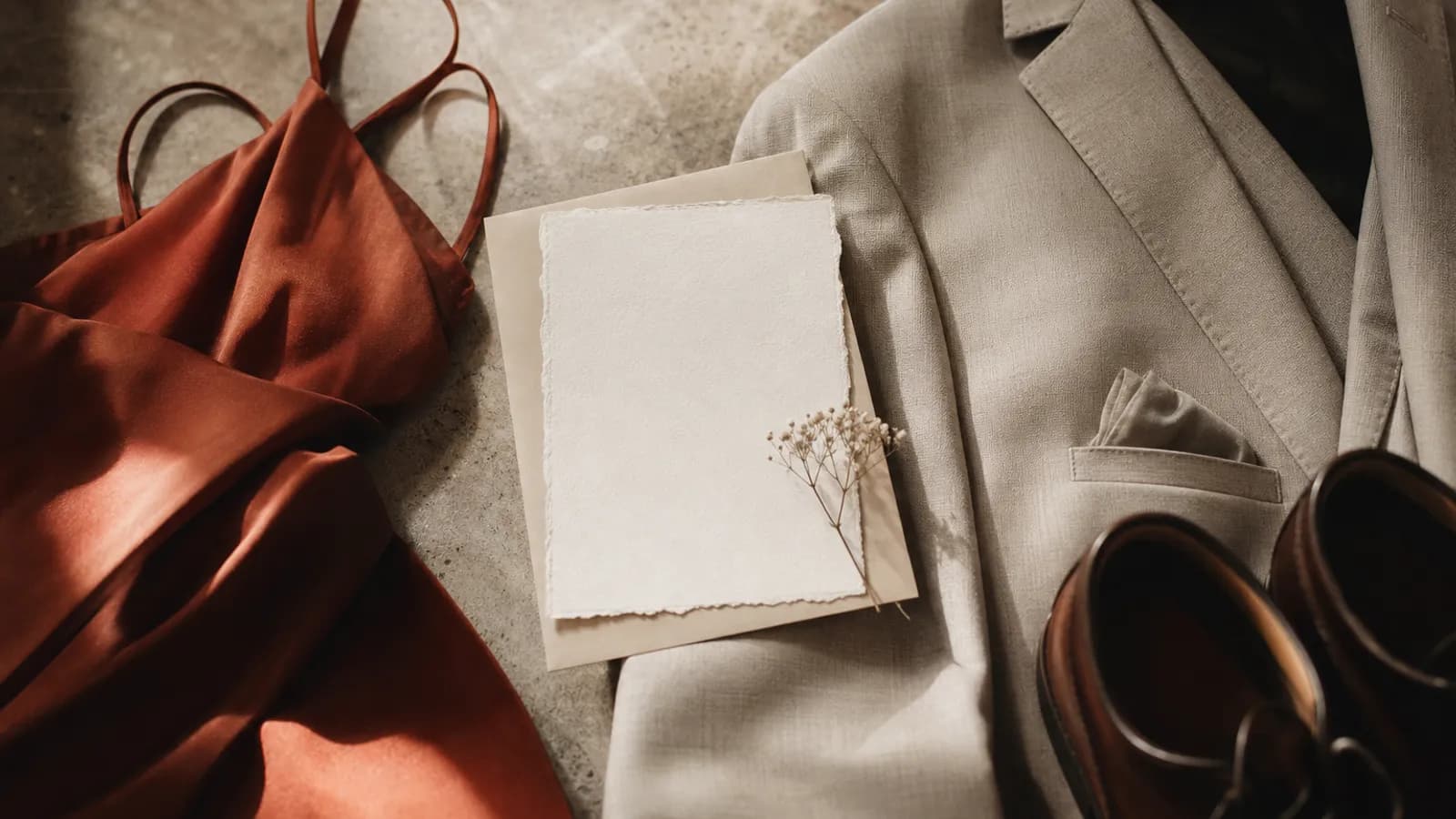
Put the dress code near the end of the invitation, after the date, time and venue, as one short line. Name the level of formality first, then add a practical hint if the ground, the weather or a colour could cause doubt: "Dress code: cocktail. The ceremony is on the lawn, so choose shoes you can walk on grass in."
A specific line helps guests more than "festive" or "dressy" on its own. This guide is part of our wedding invitation wording guide.
The clearest formula
Dress code: [level of formality]. [Practical hint]. [Colour request, if any].
Example: "Dress code: semi-formal. We're outside on a vineyard terrace until late, so bring a layer for the evening. Please leave white to the bride."
Where to put the dress code
On a short invitation, keep it close to the bottom, after the practical details. Guests read the date and place first, then look for what to wear.
- Choose the level of formality. Don't start with colours or a theme.
- Name the dress code. Use a term your guests already know, such as black tie, cocktail or smart casual.
- Add only the hint that changes what people wear. Grass, sand, cold evenings, a church with covered-shoulders rules, or two events with different codes.
- Ask someone outside the planning to read it. If they have to ask you what to wear, make the line more specific.
| Where on the invitation | What to write there |
|---|---|
| Bottom of the invitation | One short line: "Dress code: cocktail." |
| Details card or details section | Terrain, temperature, reserved colours, or a note for each event. |
| Wedding website or FAQ page | Outfit examples or an optional palette, without hiding the basic code. |
Don't make guests work out the formality from the font, the venue or the start time. If you expect a specific garment, such as a tuxedo or morning suit, name it. On a digital invitation, keep each hint to one short sentence so it reads well on a phone, as in our guide on how to word a digital invitation.
What each dress code means
Most guests in the US and UK recognise the same handful of terms, but they read them differently. A UK guest may hear "black tie" and pick a knee-length cocktail dress, which Debrett's describes as the most popular choice at British black-tie events. Many US guests will hear the same words and reach for a floor-length gown. A short hint closes that gap.
| What to write | What it usually signals | What to clarify |
|---|---|---|
| White tie | The most formal evening code: tailcoats and full-length gowns | Only use it if you really mean it. Very few weddings need it |
| Black tie | Tuxedo or dinner jacket with a bow tie, evening dress or equivalent | Whether evening dresses should be floor-length |
| Black tie optional | Tuxedo welcome, dark suit and tie also fine | That a dark suit is genuinely enough |
| Morning dress (UK) | Formal daytime wear: morning coat, or an equivalent formal daytime outfit | Whether a lounge suit is also accepted |
| Formal | Dark suit and tie, evening dress, dressy jumpsuit or smart separates | Name specific garments if you want to avoid different readings |
| Cocktail | Suit, cocktail or midi dress, dressy jumpsuit. Festive, not black tie | Terrain, temperature and shoes |
| Semi-formal | A step below cocktail: suit or blazer, dress, smart separates | Give two outfit examples and say what to avoid |
| Dressy casual or smart casual | Tie optional, no jacket required, no jeans or sportswear | Whether denim is acceptable |
| Garden attire | Light fabrics, colour and prints, daytime dressy | Grass, heels and evening temperature |
| Beach formal or beach casual | Linen, breathable fabrics, no heavy suits | Sand, wind and whether shoes come off |
Semi-formal is the code you are most likely to use and the one that needs the most help. According to The Knot Real Weddings Study, which surveyed nearly 10,000 US couples married in 2023, 62% chose a semi-formal wedding. Because so many weddings share the label, it tells guests less than you might think. Two outfit examples fix that.
A theme is not a level of formality
A palette or theme sits on top of the code: "Cocktail, in earth tones" or "Black tie, with masks". It never replaces the information about formality.
What each dress code looks like
Floor-length evening gowns and tuxedos with bow ties. The most formal level, so only ask for it if you really expect it.
Customize the dress code on your invitation
Pick the style, your palette and the colors to avoid. Your guests see the illustration in your colors on your digital invitation.
Customize my invitation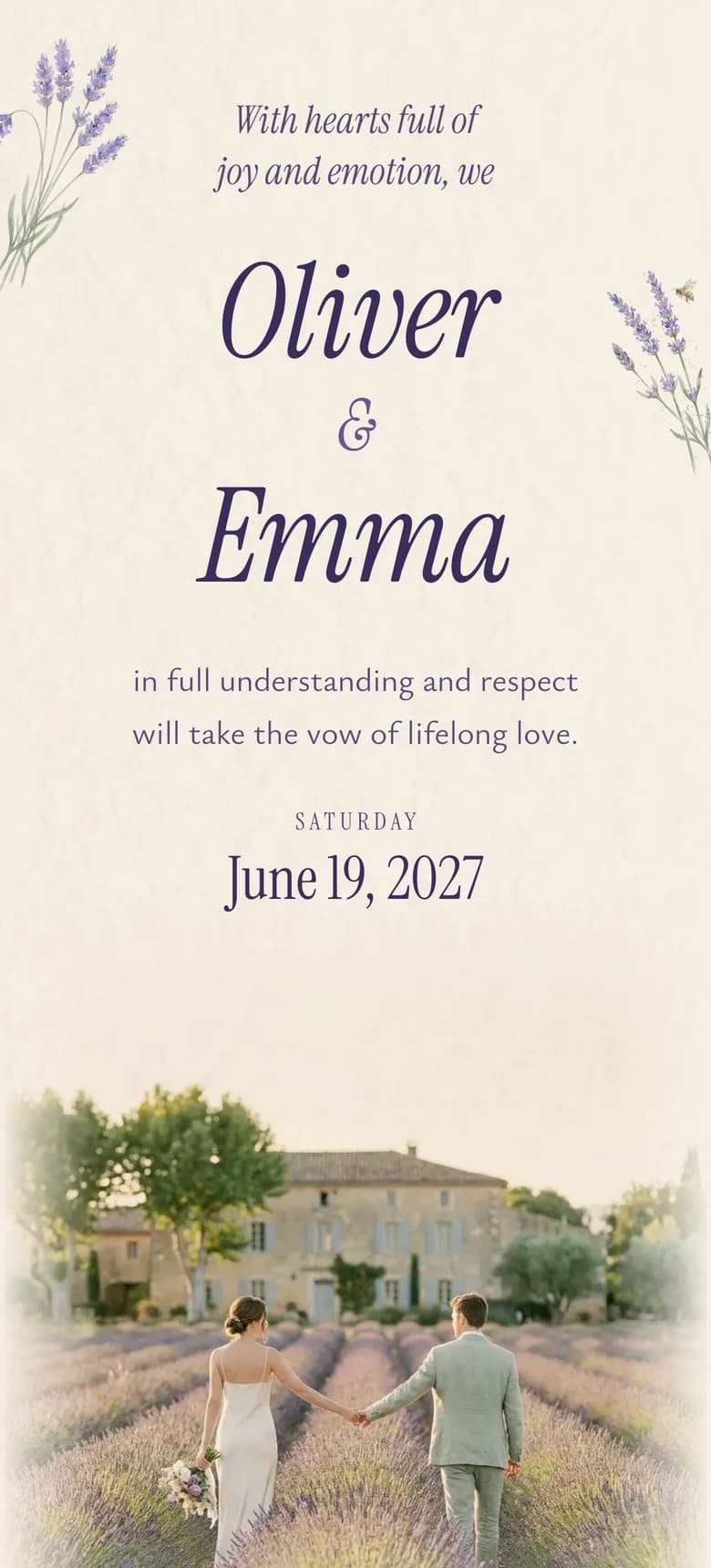

How to choose the dress code for your wedding
The venue and the time of day point you in a direction, but they don't decide for you. Choose the level you actually expect, then explain anything that changes shoes or layers. The code should also agree with the style of the invitation. A black-tie line on a barefoot-beach design confuses people.
| If your wedding is… | A useful code | The detail that prevents questions |
|---|---|---|
| An evening ballroom or hotel reception | Black tie or black tie optional | Say whether a dark suit is enough |
| A daytime church ceremony | Formal, semi-formal or morning dress | Covered shoulders or head coverings, if the church asks for them |
| A garden, barn or vineyard | Cocktail or garden attire | Grass, gravel and how cold it gets after sunset |
| On the beach | Beach formal or beach casual | Sand, wind and light fabrics |
| Themed | Level of formality plus the theme | Whether one accessory is enough or you expect a full outfit |
The details your guests need
Terrain and shoes
If there is grass, gravel, cobbles or sand, say so. "Garden attire. The ceremony is on the lawn, so block heels or flats will be easier" helps a guest choose far more than a style label with no information about the ground.
Day to night
If the ceremony starts in the afternoon heat and dinner ends outside after dark, tell people: "Ceremony in the garden at 3 pm, dinner and dancing outdoors until late. Bring a layer for the evening." The same idea works when two events have different codes. Give each event its own line.
Garments and mobility
Describe the formality and offer options such as a suit, a dress, a jumpsuit or smart separates. Don't assign each garment to a gender. "Black tie: tuxedos and evening wear" works for every guest. If the ground is uneven, say that flat shoes and adapted clothing are welcome, so guests with mobility needs don't feel they have to choose between comfort and the code.
How to reserve colours or suggest a palette
A reserved colour is one you ask guests not to wear, usually because it belongs to the couple or the wedding party. Never write "reserved colours" on its own. Name the colours and say who they are for.
| What you want | A line ready for the invitation |
|---|---|
| A colour to avoid | "Please avoid white, ivory and cream." |
| A colour reserved for someone | "Sage green is reserved for the bridal party." |
| An optional palette | "If you'd like, choose earth tones. There's no need to buy anything new." |
Avoiding white is still the default expectation at most weddings, so you don't have to spell it out. If you want to be certain, one polite line is enough. If you would love guests in all white, say that just as clearly, because nobody will assume it.
If the wording is ambiguous
Don't buy an outfit based on a phrase that could mean two things. Ask the couple for two details: one outfit that fits the level they expect, and the exact colours to avoid. Couples almost always prefer the question to the guess. For phrasing across the rest of the invitation, see our wedding invitation wording examples.
Dress code questions couples ask
If it were our wedding, we would choose a line a guest could understand without searching for the term. We would name the level of formality, the ground underfoot and any reserved colour. Then we would send it to one friend outside the planning and ask what they would wear.
Dress code lines for every kind of wedding
Filter by type of wedding, or search for words like garden, beach, black tie or white. Copy a line and adapt it to your invitation.
20 lines
- 01
Black tie
FormalDress code: black tie. Tuxedos or dinner jackets, and evening wear.
- 02
Black tie optional
FormalBlack tie optional. Tuxedos are welcome, and a dark suit and tie is just as right.
- 03
Formal with options
FormalDress code: formal. A dark suit, an evening dress, a dressy jumpsuit or smart separates.
- 04
Morning dress
FormalMorning dress or lounge suits for the ceremony. Evening wear is not required.
A UK convention. Explain it if you have many guests from abroad.
- 05
Cocktail
CocktailDress code: cocktail. Think a suit, a midi dress or a dressy jumpsuit.
- 06
Semi-formal
CocktailSemi-formal. A suit or blazer, a dress or smart separates. Ties are optional.
- 07
Smart casual
CocktailSmart casual. Dressed up a little, but please skip jeans and trainers.
US guests may say sneakers. Pick the word your guests use.
- 08
Ceremony on grass
Garden and beachGarden attire. The ceremony is on the lawn, so block heels or flats will be easier.
- 09
Gravel paths
Garden and beachCocktail attire. The paths are gravel, so choose shoes you can walk in.
- 10
Beach
Garden and beachBeach formal. We will be on the sand, so choose light fabrics and flat shoes.
- 11
Day to night
Garden and beachCeremony in the afternoon, dinner outdoors until late. Bring a layer for the evening.
- 12
White reserved
ColoursWhite is reserved for the bride. Thank you for choosing another colour.
- 13
Several shades to avoid
ColoursPlease avoid white, ivory and champagne. Every other colour is welcome.
- 14
Optional palette
ColoursIf you'd like, choose sage, olive, sand or terracotta. There's no need to buy anything new.
- 15
All white
ColoursWe'd love everyone in white or cream. It's a wish, not a rule.
- 16
Masquerade
ThemedDress code: black tie, with masks.
- 17
Twenties
ThemedCocktail attire with a nod to the 1920s.
Say that one detail is enough so nobody thinks you expect a full costume.
- 18
Earth tones
ThemedDress code: cocktail. If you like, add a touch of earth tones.
- 19
No dress code
RelaxedNo dress code. Wear something comfortable and celebratory.
- 20
Comfort first
RelaxedCome as you feel comfortable celebrating. We only ask for shoes that work on grass.
When you've chosen a line, open a template and see how it reads beside the date, the venue and the RSVP.
See templatesAbout the author
Wedding invitations, RSVP and save the date
Larisa writes the Saventify wedding guides. She covers digital invitations, save the dates, RSVP, guest lists and the templates couples actually send.
All articles by Larisa